
 indospear
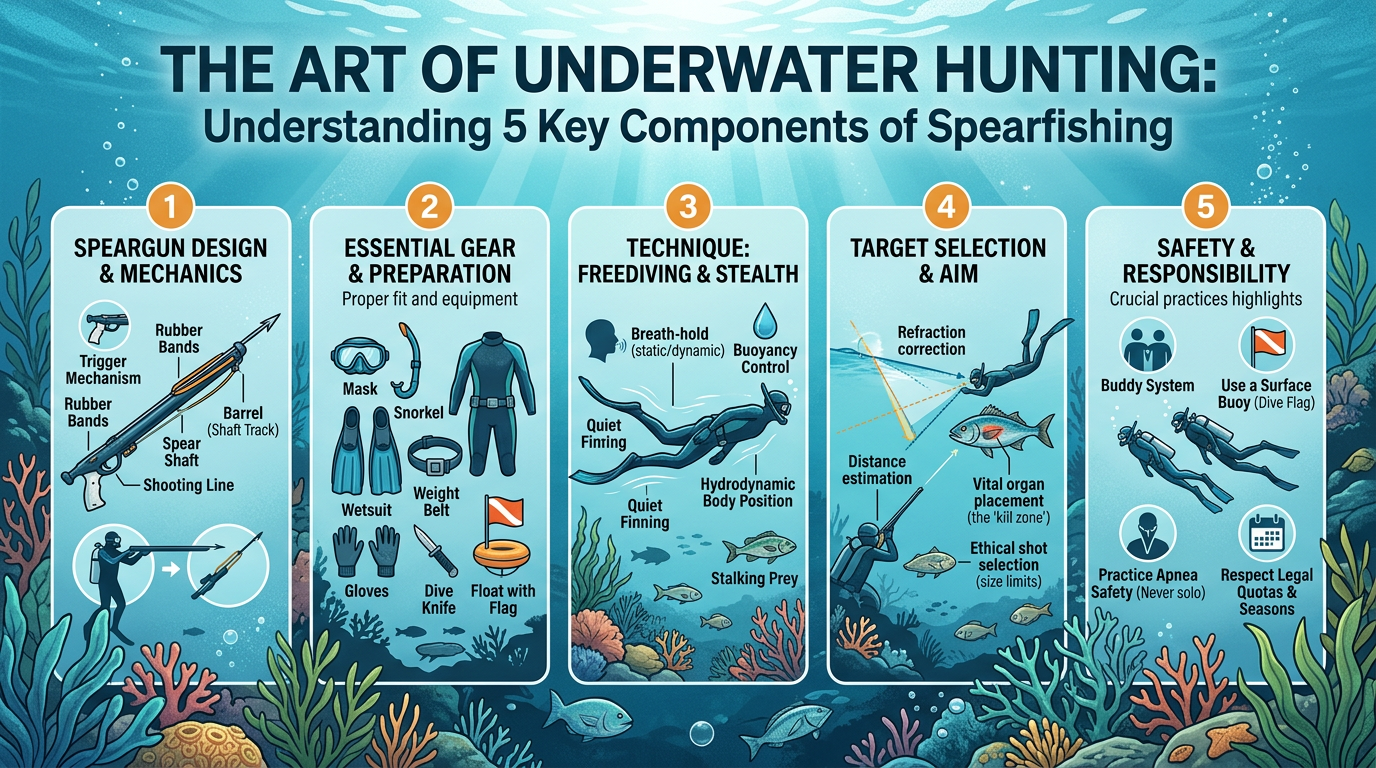
Spearfishing—the practice of hunting fish using a spear—is one of the oldest fishing methods in the world, having evolved into both an extreme sport and a challenging hobby. Unlike conventional fishing, which relies on bait and patience from above the water’s surface, spearfishing requires the practitioner to enter the marine habitat, hold their breath (freediving), and selectively hunt their target.
Because it takes place in a high-risk underwater environment, this activity should not be approached carelessly. A “spearo”—the term for someone who practices spearfishing—must understand five fundamental, interconnected components to ensure that the hunt is conducted safely, effectively, and in an environmentally responsible manner.
1.Essential Equipment (Spearguns and Pole Spears)
The most crucial component that distinguishes spearfishing from recreational freediving is the hunting gear. Generally, there are two primary types of weapons used:
Speargun: An underwater weapon that utilizes the power of rubber bands or air pressure (pneumatic) to propel a metal shaft. Spearguns offer high accuracy and range, making them ideal for hunting in open water (blue water) or targeting large pelagic fish.
Pole Spear: A long spear made of carbon or fiberglass, equipped with a rubber loop at the base. The user relies on manual strength to stretch the rubber, releasing it when the target is within close range. This tool is highly effective for hunting reef fish that hide within crevices in the rocks.
2.Freediving Equipment
MaFreediving Equipmentsk and Snorkel: A low-volume mask is crucial, as it allows the diver to equalize pressure easily while descending to depth. A snorkel, meanwhile, is used for breathing at the surface while observing the movement of fish below.
Fins: Long-bladed fins, specifically designed to provide maximum propulsion with minimal effort, help divers conserve their oxygen reserves. Wetsuit: A camouflage-patterned wetsuit serves a dual purpose: it protects the body from hypothermia while obscuring the diver’s silhouette, making them less conspicuous to fish.
Weight Belt: This is used to neutralize the positive buoyancy of the body and the wetsuit, enabling the diver to descend smoothly toward the seabed.
3.Safety Equipment and Accessories
Safety is the absolute priority in spearfishing. The underwater environment presents various potential hazards, ranging from strong currents to the risk of becoming entangled in lines. Key safety components include:
Surface Marker Buoy (SMB): A brightly colored buoy connected to the diver or the speargun via a specialized line. It alerts passing vessels to the presence of a diver beneath the surface and serves as a resting point or a container for the catch.
Dive Knife: Worn on the arm or calf for quick and easy access. This tool is essential for cutting lines in the event of entanglement, as well as for dispatching the catch quickly and humanely (using the ikejime method).
Gloves: These protect the hands from sharp coral, the venomous spines of certain fish species, and friction from fishing lines when handling struggling fish.
4. Diving Techniques and Physical Ability (Freediving Skills)
Having a full set of gear means little without mastering the necessary diving techniques. A diver must be proficient in relaxation breathing (breathe-up) before a dive, the “duck dive” technique for descending into the water without creating noisy splashes, and equalization methods to balance air pressure in the ears. Furthermore, physical endurance and mental composure are critical in determining how long a diver can safely hold their breath, without the risk of a “shallow water blackout” (loss of consciousness due to oxygen deprivation while ascending toward the surface).
5.Ecosystem Knowledge and Hunting Ethics (Environmental Awareness & Ethics)
The final component—which often distinguishes a true hunter from someone who harms the natural environment—is an understanding of the marine ecosystem. Those who engage in spearfishing must understand the behavior of their target fish, be able to read ocean currents, and be familiar with tidal patterns.
Store: bintangspear.com